


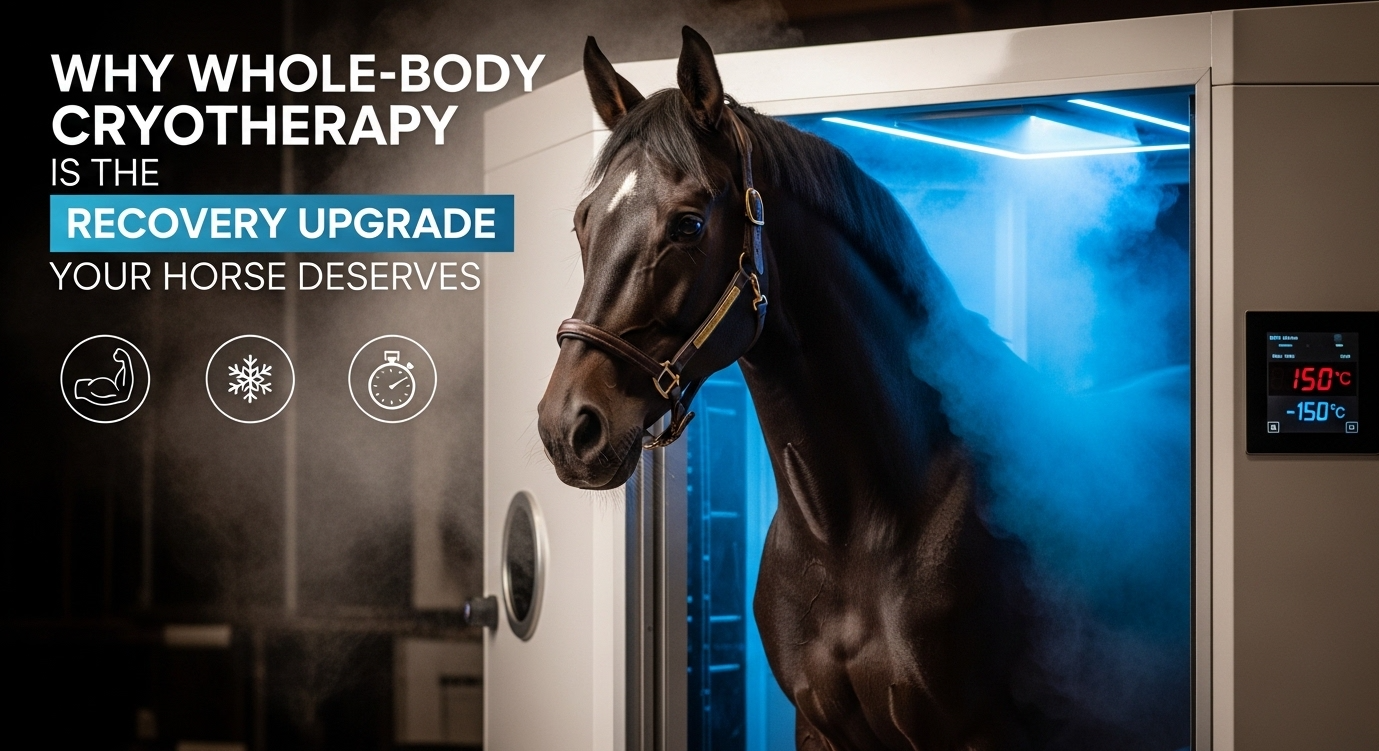
You know the feeling. You’ve just finished a championship run, a grueling cross-country round, or an intense training session. The adrenaline fades, and the reality of recovery sets in. For you, it might be an ice bath or a protein shake. But for your horse, the stakes—and the physical toll—are exponentially higher.
For years, the equestrian world has relied on cold hosing, ice boots, and perhaps a liniment rub to bring a horse’s temperature down. While better than doing nothing, these methods treat the surface level. They cool the skin but often fail to reach the deep muscle tissue or the systemic inflammation that occurs after heavy exertion. I learned this lesson the hard way about a decade ago with an off-the-track Thoroughbred named Archie. He had the heart of a lion but the joints of a porcelain doll. We spent countless hours icing his legs, yet every Monday morning after a weekend competition, he was stiff, sore, and moving like a rusted gate. It wasn’t until I started researching whole-body therapies used in human sports medicine that I realized we were fighting a losing battle with outdated tactics.
The Hidden Cost of Delayed Recovery
Most owners focus on visible leg swelling, but the real enemy is invisible. When a horse exercises at high intensity, micro-tears occur in the muscle fibers. This triggers an inflammatory cascade. While inflammation is a natural part of healing, unmanaged inflammation becomes a cycle of chronic pain and stiffness.
The complications go beyond sore muscles:
-
Oxidative Stress: Intense exercise creates free radicals that damage cell membranes, leading to fatigue and slower healing.
-
Joint Overload: When muscles are fatigued and refuse to support the skeletal structure, joints and tendons take the excess load, raising the risk of soft tissue injury.
-
Metabolic Waste: Lactic acid and other metabolic byproducts pool in the tissues, causing stiffness 24 to 48 hours after the event.
The Financial Reality: A single week of unplanned downtime due to stiffness or minor injury can cost a competitor hundreds in veterinary exams and lost training time. A major ligament injury can end a season—or a career—carrying a price tag of thousands in surgical and rehabilitation fees.
A Smarter Approach to Equine Wellbeing
This is where the science of performance recovery for horses has evolved beyond traditional limitations. Instead of relying solely on localized ice packs that cool the skin’s surface, advanced whole-body cold-air therapy works on a physiological level. By exposing the horse’s entire body to precisely controlled, sub-zero dry air, we trigger a deep physiological response. The extreme cold signals the body to shut down superficial blood vessels (vasoconstriction), sending blood rushing to the core. When the horse exits the chamber, the vessels rapidly dilate, flooding the muscles and joints with oxygenated, nutrient-rich blood. This flush removes metabolic waste, reduces nerve conduction velocity (pain), and accelerates the body’s natural repair mechanisms.
Quantifiable Gains: What the Data Shows
When you transition from guesswork to science-backed recovery, the metrics shift dramatically. Owners who integrate whole-body cryotherapy consistently report specific, measurable outcomes:
-
Reduced Muscle Soreness: Significant reduction in muscle stiffness and pain within 24 hours post-exercise.
-
Increased Training Frequency: Ability to maintain high-intensity training schedules without the accumulation of fatigue-related injuries.
-
Lowered Reliance on Pharmaceuticals: A visible reduction in the need for NSAIDs or steroid interventions, supporting a drug-free, competition-legal profile.
-
Improved Joint Function: Enhanced synovial fluid viscosity, leading to greater range of motion in arthritic or post-surgical joints.
-
Faster Return to Baseline: Horses return to a resting heart rate and normal tissue temperature significantly faster than with passive rest alone.
-
Enhanced Sleep Patterns: Owners report deeper, more restorative sleep patterns in treated horses, which is critical for the release of growth hormone and tissue repair.
The Technical Breakdown: Why Cold Air vs. Ice?
You might ask, “Why replace ice boots with a cryo chamber?” The answer lies in thermodynamics and biology. Ice conducts cold efficiently but unevenly; it often damages the skin barrier if left too long (causing ice burns or “freeze branding”). Cold air, particularly when circulated as a dry gas, removes moisture and penetrates evenly without the risk of localized tissue damage associated with direct ice contact.
Furthermore, the inclusion of the head in the therapy is a game-changer. Seventy percent of the body’s thermoreceptors are located in the head and neck. If you chill only the legs, the brain doesn’t get the full signal to trigger the systemic vasodilation response. You essentially turn off the engine while leaving the air conditioner running. Whole-body treatment ensures the nervous system gets the message loud and clear, maximizing the release of anti-inflammatory cytokines and natural painkillers.
Personal Experience: The Archie Transformation
Returning to Archie. At 17, his joints were creaky, and his recovery window had stretched from two days to nearly four. Traditional rehab wasn’t cutting it. On a whim, we booked a few sessions in a mobile whole-body unit. The first session was tentative; he was wary of the cold mist. By the third session, he was walking into the chamber like he was heading to his dinner stall.
The results weren’t just visual; they were tactile. The chronic heat in his fetlocks dissipated. The tightness in his back—a telltale sign of compensating for sore hind legs—vanished. We went from a horse who needed a week off after a heavy workout to a senior athlete who could comfortably perform light work the very next day. It wasn’t a miracle cure for his age, but it was the closest thing to turning back the clock I have ever witnessed.
Who Benefits Most?
The Elite Competitor
For horses competing in racing, eventing, dressage, or show jumping, the stress on soft tissue is immense. Whole-body cryotherapy acts as a proactive maintenance tool. It allows for harder training loads without the corresponding spike in injury risk.
The Laminitic or Inflammatory Case
Laminitis is a vascular emergency. Research shows that consistent distal limb cooling can significantly slow the enzymatic destruction of the laminae. While whole-body therapy is a powerful wellness tool, targeted cold application for acute laminitis remains a critical veterinary intervention.
The Rehabilitating Athlete
Returning to work after a tendon or ligament injury is a psychological and physical tightrope walk. Cryotherapy reduces the fear of re-injury by maintaining low inflammation levels in the healing tissue, allowing for a smoother transition back into the training regime.
The “Layering” Strategy for Success
Cryotherapy is not a magic bullet. It works best when layered with solid husbandry. You cannot freeze a horse back to health if it is standing in a dirty stall eating poor-quality hay.
-
Hydration is non-negotiable. The vasodilation effect requires adequate blood volume to flush toxins. Dehydrated horses will not respond as well.
-
Nutrition matters. Pair cryotherapy with a high-quality Omega-3 supplement to manage systemic inflammation from the inside out.
-
Manual Therapy. Combining cryotherapy with body work or massage helps mechanically realign fibers that have been chemically relaxed by the cold.
Why Choose MAXCRYO?
MAXCRYO brought the UK’s first whole-body equine cryotherapy chamber to the market, built on 18 years of hands-on experience. The difference lies in the precision. We don’t just cool the horse down; we follow a specific protocol based on the horse’s muscle mass, coat condition, and current workload. The chamber encompasses the whole body—including the head—to ensure the 70% thermoreceptor rule is activated, triggering a deep, systemic healing response that ice boots simply cannot achieve.
Your Next Step
Stop accepting “stiffness” as a normal part of equine athletics. It is a sign of incomplete recovery. If your horse is taking longer to bounce back than it used to, or if you are tired of watching your animal move like a robot for two days after a show, it is time to upgrade your toolkit. The era of ice buckets is fading. The future of equine sports medicine is here, and it is cold, dry, and remarkably effective.
Frequently Asked Questions (FAQs)
1. How long does a MAXCRYO session take?
Each session is remarkably brief, typically lasting between three to five minutes depending on the horse’s size and the specific therapeutic goal. The machine uses dry sub-zero air, so the horse does not get wet or cold to the bone.
2. Is cryotherapy safe for nervous or young horses?
Yes. The MAXCRYO chamber is designed with a gradual entry protocol. Horses are led into a controlled environment where the temperature drops slowly. Most horses become accustomed to the sensation within their first or second visit, and many learn to relax deeply during the process.
3. Can cryotherapy help with acute injuries like splints or windpuffs?
Absolutely. For acute soft tissue inflammation, cold therapy is the gold standard. It slows the inflammatory cascade and reduces edema (swelling) far faster than rest alone. For best results, we recommend treatment as soon as possible after the injury occurs.
4. How soon after a competition can my horse receive treatment?
Immediately. In fact, treating within 30 to 60 minutes of intense exertion is the “sweet spot” for maximizing performance recovery for horses. It intercepts the inflammatory cascade before secondary tissue damage sets in.
5. Will this make my horse lame or stiff from the cold?
No. Unlike ice water immersion, which can be a shock to the system, dry cold air is invigorating. Horses typically leave the chamber feeling energized and loose. Their core temperature remains stable; only the surface receptors are triggered.
6. Is it legal for FEI or British Horseracing Authority competitions?
Yes. Whole-body cryotherapy is a physical therapy modality, not a medication. It does not introduce any prohibited substances into the horse’s system. It is a fully drug-free and non-invasive treatment, making it completely competition-legal.
7. Can I combine cryotherapy with my horse’s regular physiotherapy schedule?
We highly recommend it. Cryotherapy acts as an excellent primer for body work. By reducing nerve sensitivity and relaxing muscle guarding, the physiotherapist can access deeper tissues more effectively. We call this “bio-hacking” the therapy session.
8. Are there any risks or side effects?
When administered by a trained professional, the risks are minimal. The primary rule is “short and controlled.” Unlike prolonged ice application which can cause tissue necrosis (frostbite), our dry-air protocol is timed precisely to avoid overcooling. We never exceed the thermal threshold of the horse’s skin.
9. How often should a horse receive cryotherapy for maintenance?
For elite athletes in full work, 3 to 4 sessions per week is common to manage training load. For leisure horses or seniors, a maintenance session once a week or bi-weekly can effectively manage arthritis symptoms and general stiffness.
10. Will the head chamber frighten my horse?
No. The chamber is open and transparent. The horse can see its handler and surroundings at all times. The head is not enclosed in a tight space; rather, the cold air circulates gently around the face. Because the horse can still see and smell familiar people, stress levels remain exceptionally low.